Balance · 7 min read
Aromatic Rituals for Relaxation at Home: How to Begin
By Margaret Holloway · May 14, 2026
I used to think the difference between a tense evening and a restful one was a matter of willpower. If I just decided to relax harder, surely my shoulders would drop. Then, one slow February afternoon in my Toronto apartment, I lit a small bowl of dried lavender on the stove, opened a window an inch, and sat on the floor while the kettle hummed. Twenty minutes later, the day looked different. Nothing had changed except the air around me.
That afternoon began my long, curious experiment with scents at home. Not as a quick fix, not as a glamorous lifestyle product line, but as a daily practice of paying attention. In this letter I want to share what has worked for me, what I have read about in WHO well-being notes and Harvard public-health newsletters, and how anyone can begin, even in a small rented kitchen.
Why scent has such a quick effect on mood
Our sense of smell is the only sense wired almost directly to the parts of the brain that handle memory and emotion. According to materials published by the World Health Organization on healthy environments, indoor air quality and gentle sensory input shape our well-being more than most of us realise. A single warm note — orange peel on a radiator, pine needles in a bowl — can transport us before our thinking mind catches up.
This is exactly what makes scent so useful for everyday balance. We are not asking it to fix anything dramatic. We are asking it to remind us, again and again, that the body is allowed to soften.
A scent does not solve a hard day. It simply opens a small door in the middle of it — and that turns out to be enough.
The four scent families I keep coming back to
After two winters of experimenting, I have narrowed my favourites to four families. You do not need them all. Picking one or two is enough to start.
- Floral — lavender, rose, neroli. Soft, hugging, end-of-day notes that pair well with slow reading and warm baths.
- Citrus — bergamot, sweet orange, grapefruit. Bright morning anchors. Generally promotes a feeling of openness when I am writing or tidying.
- Woods and resins — cedar, sandalwood, frankincense. Grounding scents for autumn and winter evenings, especially after long screen days.
- Herbal greens — rosemary, eucalyptus, peppermint. Crisp, focused, the kind of air I want around me before a difficult conversation.
Five gentle ways to bring scent into your day
01
Open the morning with citrus
Drop two strips of orange peel into a mug of hot water as you make coffee. The kitchen smells alive within a minute and you have spent nothing extra.
02
Build a five-minute wind-down ritual
At the same time each evening, light a single candle or warm a ceramic diffuser with three drops of lavender. The repetition signals the body that the workday has closed.
03
Make a desk pocket inhaler
A small glass jar with cotton soaked in rosemary or peppermint sits in my drawer. Two slow breaths over it after a long video call brings me back into the room.
04
Refresh linen with a hydrosol mist
A diluted rose or chamomile hydrosol on pillows and curtains is a quiet way to mark “this is rest time” without changing your whole apartment.
05
Use scent to close the week
On Friday evenings I burn a tiny stick of cedar resin for two minutes. It is my personal punctuation mark between work-self and home-self.
Quick safety notes
Always dilute essential oils before applying to skin and keep them away from children and pets. Ventilate the room and never leave open flames unattended. If you are pregnant, nursing or living with someone who has respiratory sensitivities, talk with a qualified specialist before introducing new scents at home.
Building a tiny home altar of senses
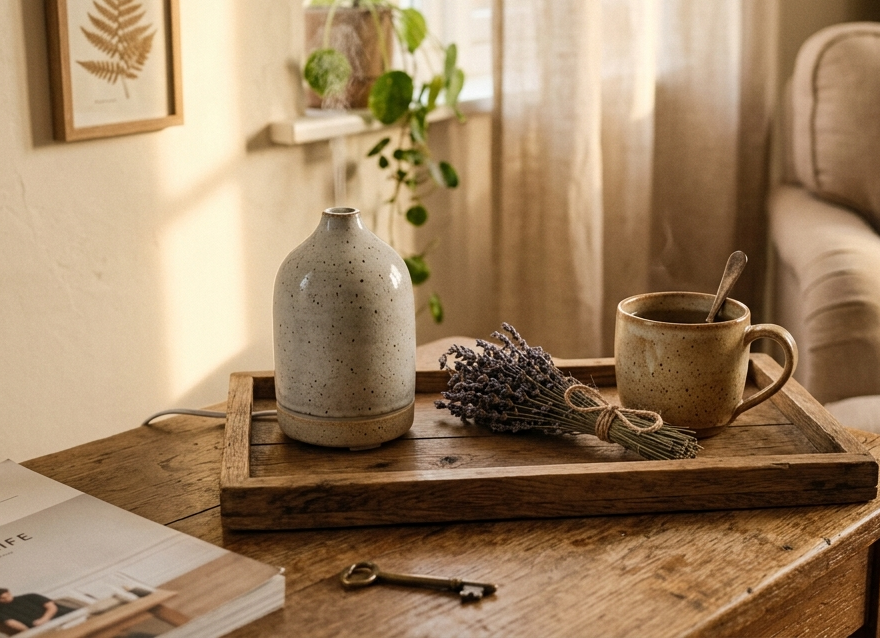
One of the kindest pieces of advice I received came from a Montreal florist, Daniel: “Give scent a place to live.” I now keep a small wooden tray in the corner of my living room. On it sits one ceramic diffuser, a glass jar of dried lavender, a stoneware cup for matches, and a folded linen cloth. Nothing fancy. But every time I walk past, my eyes know what the tray is for, and so does my nervous system.
If you have only a windowsill, that is plenty. If you share a small flat, choose one shelf. The point is not the aesthetic; it is the cue. As Harvard well-being writers often note, environments shape habits far more reliably than motivation.
How I choose ingredients without overspending
I am not a person who can justify a hundred-dollar candle. In my experience, the most reliable home ritual tends to be the cheapest one: dried herbs from a local market, a small bag of orange peels saved from breakfast, a single quality essential oil bought once a season. I look for clear labelling, country of origin and a simple ingredient list. If a product cannot tell me what is inside, it does not get a place on my tray.
A short shopping list to begin
- One ceramic or stoneware diffuser without electronics — the kind that uses a tealight.
- Two essential oils: lavender for evenings, sweet orange for mornings.
- A small bundle of dried herbs — rosemary or eucalyptus work beautifully.
- Unscented beeswax tealights, which burn slower and cleaner than paraffin.
What I learned by doing this for a year
The biggest shift was not in the room. It was in how I noticed myself. I started catching the moment my jaw clenched. I started recognising when I was holding my breath at the laptop. Scent became a quiet metronome reminding me to come back to the body again and again. Research indicates that small, repeatable sensory cues are one of the more dependable ways to anchor a daily well-being practice — and the apartment-sized version is the one I recommend most often to friends.
Self-care is rarely loud. It is mostly a series of soft, unfussy gestures the body learns to expect.
An invitation, not a prescription
If you take one thing away from this piece, let it be permission. You do not need a perfect routine, a beautiful diffuser or an empty Saturday morning. You can begin tonight with a piece of orange peel on a warm radiator. According to experts in everyday well-being, what matters is not the volume of the gesture but its honesty.
Below the divider you will find three more letters from the project — small, slow reads on energy, attention and the words we use about ourselves. I hope one of them keeps you company.
Balance
Lifehacks to Preserve Energy in Conversations
How small linguistic and listening habits keep you from arriving home empty.
Read →
Balance
How Social Media Shapes Our Inner Calm
An honest look at scrolling, comparison and the small habits that quiet it down.
Read →
Balance
How to Replace “I Should” with “I Want”
A gentle vocabulary shift that changes the way a whole week feels.
Read →
About the project
Sportpace is a slow magazine for readers who want their well-being writing without hype or jargon. Margaret and Daniel share rituals, stories and gentle research from Toronto and Montreal. Generally helps to know that the people writing here are figuring it out alongside you.
Our story
Letters from Sportpace
One slow, thoughtful letter a month: rituals, recommendations and quiet observations on self-care. No noise.
This content is for informational purposes only and is not a substitute for professional advice. Consult a qualified specialist before starting any new fitness or wellness program. Information on this blog is based on open sources and personal experience. It does not replace medical consultation.